
If you already have an online business or niche, one major thing you need to learn is how to research keywords for a niche in order to reach your target audience.
Using the right keywords is an integral part of your SEO journey as this will make your business and website to rank high and appear top of search engines result page, whether you run a B2B website or a B2C website, you need a proper knowledge about keyword and keyword research.
Keyword research is the process of finding out what your target audience is searching for based on search volume( how often they search) competition levels, ( how difficult it is to rank) and search intent (the intent behind their given search queries)creating content around it to solve their problems and this varies from niche to niche.
Each search intent varies one from the other, for example someone searching for “ How to repair a laptop “ has informational intent while “ Where to Buy a Dell Laptop Near Me “ has transactional intent.
Understanding this concept will help you create content to solve the search queries of your target audience in your niche.
Each Niche Keyword are highly competitive, it is important you carry out your research correctly to be able to appear on search results, don’t worry this blog post will provide you with everything you need to help your website appear on search engines.
How to research for keywords in a niche
For you to appear on google irrespective of the niche you are into, you need to follow this keyword research guidelines
Step 1: Identify your ideal client profile and build Seed Keywords
One of the first things you must do is to identify your ideal client profile and target them. It is more of meeting the right audience and finding out what keep them surfing the internet by 1:00 AM.
Your ideal client profile will help you understand your target audience more, their demographic ( who they are) , psychographics ( How they think) pain point ( why they need you) Triggers ( what makes them take action) and online hangouts ( where to find them).
The thing you need to do after identifying your ideal client profile is to build seed keywords. Seed keywords are phrases that try to suggest what your target audience is searching for.
To be able to build a seed keyword, write down 5-7 pain points your customers face and then turn it into phrases related to your niche.
For example if you run a software development company, your seed keyword might include “ software to automate business processes”.
Step 2: Use Keyword Tools to find Niche Keywords
After generating your seed keywords, the next thing you need to do is to feed it into a keyword research tool to validate your seed keywords.
You can make use of a free keyword tool by word stream or some other keyword research tools like Google Autocomplete, People Also Ask, Google Keyword Planner and Google Trends.
There are also paid research tools you can use to get a better result, some of them include :- Ahrefs, SEMrush, Ubersuggest and Moz.
These Keyword research tools help you identify a wide range of potential keywords that will drive potential traffic to your website.
In conducting keyword research, ensure you go for long-tail keywords which have a lower search search volume, but high conversion rate.
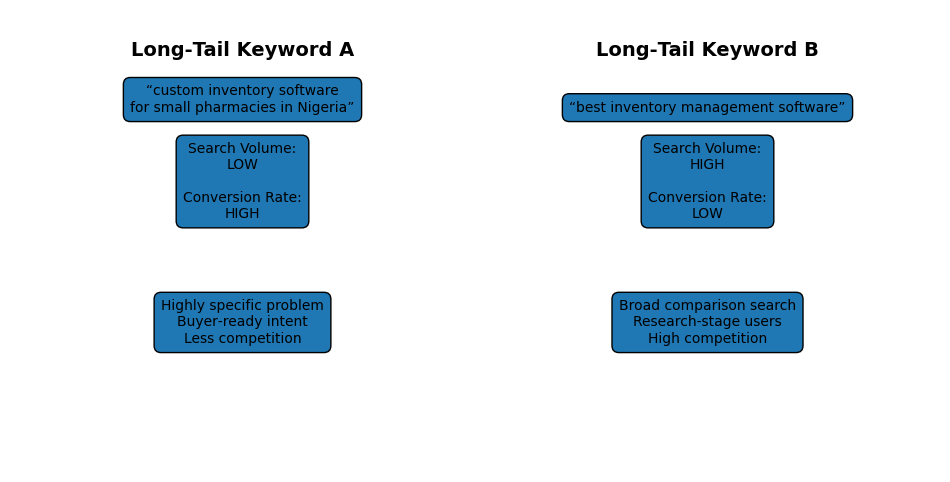
The diagram above shows two Long tail keywords A and B. The one on the left “ custom inventory software for small pharmacies in Nigeria “ might have a small search volume but have solved a specific problem.
Searchers already know the industry, location and solution and this will give the owner of the website a high conversion rate.
The other keyword on the other hand has a higher search volume but a broader comparison intent which will lead to more website traffic but low conversion rates.
Step 3: Analyze User Search Intent
Search intent is the reason behind your audience’s search query. Google will rank your content if it matches search intent and not just keywords.
There are four main types of search intent:
- Informational: in this type of search intent,the online user wants to learn or research about a topic or concept (e.g., “how to train female dogs”)
- Commercial: in this type of search intent, the user wants to compare multiple options in order to make financial decisions (e.g., “best laptop for gaming”)
- Transactional:Here the user is ready to buy after comparing multiple options(e.g., “buy Gaming Laptop ”)
- Navigational:Here the online user is searching for a specific site (e.g., “Facebook login”)
Your content must align with what users expect to see before you can be able to rank high on Google and other search engines..
Step 4: Steal from your Competitor’s website
Getting keywords from a competitor’s domain is one of the fastest ways to conduct keyword research for a niche.
You can do this using Ahref site explorer or Semrush’s Organic Research Tools.
All you need to do is just to your competitor’s domain, then filter their organic keywords using question modifiers ( who, what, where, when, why and how), analyze them by traffic to find out their top ranking pages.
The aim of doing this is not to copy their content but to find out the keywords that drive organic traffic to their website. This is one of the fastest ways to generate keywords.
Step 5: Validate Search Demand and Keyword Difficulty
Check your potential keywords for monthly search volume, keyword difficulty and search engine result page validation before creating your content.
You can use Semrush Keyword explorer to find out the country where your target keywords get searches from.
A keyword with less than 100 monthly searches is not worth targeting unless it has an extremely high intent.
Also look out for keyword difficulty (KD), it is advisable you go for KD below 30 ( if you are using Semrush keyword research tool) to stand a higher chance of getting ranked but manually also review the keyword’s SERP.
Step 6: Mine your own Data for Long Tail Keywords
Your website and content must have already had valuable search insights.
What you need to do is to go to Google Analytics and look at your pages with the highest engagement or the pages with the highest average session duration and conversions.
You can also make use of Google Search Console by going to performance, clicking in queries and filtering for low impressions but high CTR pages.
Step 7: Keyword Mapping
Assign one primary keyword to each page of your website and cluster related around it in order to reduce keyword cannibalism.
One of the ways you can do this is by opening a spreadsheet and assigning keywords to your different web pages, each row representing one URL on your website.
FAQs
FAQ 1: What is keyword research in SEO?
Keyword research is the process of finding out what your target audience is searching for based on search volume, competition levels, search intent and creating good and quality content around it to solve their problems and pain point .
FAQ 2: How do beginners do keyword research?
You can carry out keyword research as a newbie by first identifying your niche and target audience, developing seed keywords that address your audience pain points and using keyword research tools to validate your seed keywords.
FAQ 3: What are long-tail keywords and why are they important?
Long-tail Keywords are Long and specific search phrases that have lower competition and clear user search intent.
These keywords are important because they are very easy to rank for and can attract more targeted organic high-quality traffic to your website.
FAQ 4: How do I know if a keyword is too competitive?
A keyword is competitive is it has a high keyword difficulty (KD) and has been written by high authoritative websites with a lot of backlinks.
FAQ 5: What tools are best for keyword research?
Some of the best tools you can use for Keyword Research are Semrush, Ahref, Ubbersuggest or Moz (paid keyword research tools).
You can also make use of Google keyword planner or Google Trends ( free keyword research tools)
FAQ 6: How many keywords should I target per page?
You are to include one keyword in each page of your website and link it with related keywords in other pages of your website In order to avoid keyword cannibalism.
FAQ 7: How often should keyword research be updated?
Keyword Research should be updated every month in order to get the current topics people are currently searching for.
Final Thought
Keyword research is the foundation of SEO and one of the Best SEO Practices for 2026, without which your website and business will not become visible in the online community.
Your niche also has a part to play in your keyword selection. Before using any keyword tool ( free or paid), you need to be specific and certain about your niche and audience.
Always try to find out Who your ideal audience or customer are, the problems they are trying to solve, their level (beginners, intermediates, or experts) and if they are there to learn, compare, or buy
For example, keyword research for a beginner SEO E commerce will look very different from keyword research for a pharmaceutical business. Understanding your audience will help you choose keywords that conforms with their goals and expectations.